Micron Technology analysis:
Micron: The Memory Supercycle Is Real — But at $935, How Much of It Is Still Yours to Buy?
- Executive Setup
- From Commodity DRAM to AI Infrastructure
- Earnings Deep Dive: FY2025–FY2026
- Capital Expenditure: The Largest Build-Out in Company History
- Structural Context: Memory as a Scarce AI Commodity
- The Bull Case
- The Bear Case & Key Risks
- Valuation vs. Micron's Own History
- Analyst Ratings & Price Targets
- The Oversupply Question: Samsung & SK Hynix
- What Would Change Our Mind
- Muffett's Take, Entry Levels & Rating Verdict
1. Executive Setup
A year ago Micron was a cyclical memory maker trading below $300 a share, valued the way the market has valued it for three decades: as a commodity producer whose earnings swing wildly with DRAM and NAND spot prices. Today it trades around $935, having reported fiscal third-quarter revenue of $41.46 billion — up 346% year-over-year — at a non-GAAP gross margin of 84.9%, an industry record that more than doubled from 39% a year earlier. The company has signed 16 multi-year, take-or-pay Strategic Customer Agreements worth roughly $100 billion in minimum committed revenue, backed by $22 billion of upfront customer cash deposits, running through calendar 2030. Management expects half or more of total corporate revenue to eventually sit inside these contractually protected agreements. This is not a modest re-rating; it is a fundamental change in how much of Micron's earnings power is locked in versus exposed to spot pricing.
The stock has moved accordingly — up roughly 206% over the past year and sitting near its all-time high. That combination, a business genuinely transformed and a share price that has already priced in a great deal of the transformation, is exactly the tension the user asked us to resolve: is Micron still buyable, or has the easy money already been made? The honest answer, laid out across this note, is that Micron is cheap on forward earnings and expensive on nearly every other yardstick simultaneously — and reconciling those two facts requires taking a real view on how long the current memory supercycle lasts.
2. From Commodity DRAM to AI Infrastructure
Micron's transformation rests on a single physical mechanic: producing High-Bandwidth Memory is extraordinarily wafer-intensive. Making one bit of HBM3E requires roughly three times the raw silicon wafer capacity of standard DDR5 DRAM, and for the next-generation HBM4 that ratio is projected to widen to four-to-one. Because HBM is now the memory of choice for AI accelerators — Nvidia's Vera Rubin platform among them — every wafer Micron, Samsung, and SK Hynix redirect toward HBM production is a wafer physically unavailable for conventional DRAM and NAND. That "wafer displacement squeeze" is the structural reason standard memory prices have risen sharply alongside HBM prices even though most of the AI capex headlines are about GPUs, not memory: Micron's cumulative HBM4 revenue surpassed $1 billion this year, with the 12-high HBM4 volume ramp progressing twice as fast as its HBM3E predecessor.
The scale of demand is now large enough to show up at the total-market level: memory (DRAM and NAND combined) is projected to account for 47% of major cloud service providers' total capital expenditure in 2026, rising to 68% in 2027, according to TrendForce data cited in our source set. Micron's own combined data-center revenue (Cloud Memory plus Core Data Center segments) surpassed $25 billion in the most recent quarter alone, putting the company on an annualized data-center run rate exceeding $100 billion — a figure that did not exist in any prior version of this company's income statement.
3. Earnings Deep Dive: FY2025–FY2026
Micron's fiscal year runs September–August, so its most recently reported quarter — fiscal Q3 FY2026, ended May 28, 2026 and reported June 24, 2026 — is the one that actually shows the AI upcycle in full force. The trajectory across the last five reported quarters tells the story on its own.
Fiscal Q3 FY2025 (ended May 2025): Revenue of $9.30 billion beat consensus of $8.83 billion by $470 million. Non-GAAP gross margin was 39.0%. Non-GAAP EPS of $1.91 beat the $1.57 estimate by $0.34, a roughly 22% surprise. HBM was still only in the low-20% range of DRAM revenue.
Fiscal Q4 FY2025 (ended August 2025): Revenue of $11.32 billion beat consensus of $11.05 billion. Full-year FY2025 GAAP gross margin came in near 40%. Non-GAAP EPS of $3.03 beat the $2.86 estimate.
Fiscal Q1 FY2026 (ended December 2025): Revenue jumped to $13.64 billion, beating consensus of $12.62 billion by just over $1 billion. GAAP gross margin expanded sharply to 56.0%, with non-GAAP operating margin reaching 47%.
Fiscal Q2 FY2026 (ended March 2026): Revenue nearly doubled sequentially to $23.86 billion against a consensus estimate of $19.97 billion — a $3.89 billion beat. GAAP gross margin reached 74.4%. Non-GAAP EPS of $12.20 crushed the $9.19 estimate by $3.01. DRAM revenue hit $18.8 billion (79% of total, ASPs up in the mid-60s% range sequentially); NAND revenue reached roughly $5.06 billion (21% of total), with NAND ASPs surging 78% sequentially on 82% sequential revenue growth, driven by enterprise SSDs (50% of the NAND mix).
Fiscal Q3 FY2026 (ended May 28, 2026) — the latest reported quarter: Revenue of $41.46 billion beat consensus of roughly $35.8–35.9 billion by approximately $5.6 billion — a 346% year-over-year increase. Non-GAAP gross margin hit an industry-record 84.9% (GAAP 84.6%), more than double the prior-year quarter's 39%. Non-GAAP EPS of $25.11 beat the $20.71 consensus by $4.40, a 21% surprise (GAAP EPS $24.67). DRAM revenue hit a record $31.3 billion (76% of total), up 343% year-over-year and 67% sequentially; NAND revenue hit a record $9.9 billion (24% of total), up 361% year-over-year and 99% sequentially. Enterprise SSD revenue alone reached $5 billion, more than doubling sequentially on vertically integrated G9 NAND and internal controllers.
Forward guidance — fiscal Q4 FY2026 (quarter ending late August 2026): Management guided revenue to a midpoint of $50.0 billion (± $1.0 billion) — another 20.5% sequential increase — comfortably ahead of the $43.45 billion Wall Street consensus at the time of the print. Gross margin guidance calls for approximately 86% on both a GAAP and non-GAAP basis. Non-GAAP EPS guidance sits at $31.00 (± $1.00) at the midpoint, roughly $5.57 above the $25.43 consensus. Management also projects adjusted free cash flow to exceed $30 billion during the quarter.
Underpinning all of this is the contractual structure discussed above: Micron's 16 Strategic Customer Agreements, spanning through calendar 2030, cover roughly 20% of DRAM volume and one-third of NAND volume, backed by $100 billion in minimum committed revenue and $22 billion in customer cash deposits already received. That is real, near-term visibility no prior Micron cycle has had — and it is the central fact bulls point to when arguing this upcycle is structurally different from the last three.
4. Capital Expenditure: The Largest Build-Out in Company History
Micron's actual capital expenditures for FY2025 came in just over $13 billion (specifically $13.531 billion under adjusted accounting). Guided net capex for FY2026 was raised repeatedly through the year — first from $25 billion to $26–27 billion, and management has since confirmed FY2026 spending will roughly double FY2025's level to approximately $27 billion. Looking further out, management has flagged FY2027 capex escalating to exceed $45 billion, with quarterly spending scaling well above $10 billion — an annualized run-rate in the low-to-mid $50 billion range. Because FY2026 revenue itself is tracking toward roughly $129.6 billion, the $27 billion in net capex actually represents a more moderate 20.8% of revenue — down from an estimated 31% of revenue when the original $20 billion capex program was announced against a much smaller revenue base. S&P Global's base case models both FY2026 and FY2027 capital outlays normalizing in the low-20% of revenue range as sales and cash flow continue climbing alongside spending.
Micron has roughly 20 active global investment projects spanning front-end wafer fabrication and back-end packaging. The two U.S. anchor projects dominate the long-run capital plan:
- Boise, Idaho (headquarters expansion): The campus is expanding to 900 acres, including a 240-acre annexation approved in August 2026, to house two advanced fabs — ID1, a $15 billion front-end project that reached its cleanroom "blowdown" pressurization milestone in spring 2026 with first wafer output expected mid-calendar 2027, and ID2, a $30 billion project targeting first wafer output in late-calendar 2028. Micron separately committed $10 billion in August 2026 to build Micron Research Labs, a long-horizon AI innovation center in Boise slated to break ground in 2027.
- Clay, New York (mega fab): Planned as a four-fab semiconductor cluster and the largest private investment in New York State history. Originally framed as a $100 billion project, Micron raised its total U.S. investment plan in July 2026 to over $250 billion through 2035, accelerating this campus. Ground broke in January 2026; the project moved to vertical construction with its first concrete pour in July 2026 (Bechtel is the EPC contractor for the first fab); first output from New York Fab 1 is targeted for calendar year 2030.
- Other global sites: a $1.8 billion acquisition of an existing Powerchip fab in Tongluo, Taiwan (leading-edge DRAM starts targeted mid-2027); a $24 billion Singapore commitment for 700,000 square feet of NAND cleanroom space plus HBM advanced-packaging capacity from H1 2027; a ¥1.5 trillion (~$9.3 billion) Hiroshima, Japan expansion for 1-gamma DRAM and HBM scaling, heavily subsidized by Japan's METI, with equipment installation targeted for H2 2028; India's first Micron semiconductor assembly and test facility in Sanand, Gujarat, which began commercial shipments in fiscal Q2 2026 (February 2026); and a modernized Manassas, Virginia site producing 1-alpha DDR4 for long-lifecycle automotive, aerospace, and defense customers.
Government support is material to the economics of this build-out. Micron has secured up to $6.4 billion in direct federal funding under the CHIPS and Science Act, tied to the two Idaho fabs and two of the New York fabs, plus a 35% Advanced Manufacturing Investment Credit on qualified U.S. semiconductor capex. The funding terms carry a cost: Micron faces share-buyback restrictions for two years post-award, ending December 9, 2026, meant to offset public investment with a temporary limit on capital return flexibility. Internationally, Taiwan committed $318 million specifically toward Micron's HBM R&D, and Japan's METI is providing substantial backing for the Hiroshima expansion.
Micron does not break out HBM-specific capex as a separate line item, but given the wafer-displacement mechanics described above, a large share of the $27 billion FY2026 program is directed at leading-edge DRAM nodes (1-beta and 1-gamma) and advanced packaging — including the Singapore HBM packaging build — specifically to support the HBM4/4E roadmap. On capex discipline, CFO Mark Murphy has been explicit that despite the SCA contracts, Micron's cost structure remains sensitive to utilization: if ASPs decline, gross margins are highly exposed to underutilized capacity, which is precisely why the Strategic Customer Agreements exist — to let Micron "invest with confidence" against locked-in demand rather than repeating the industry's historical pattern of overbuilding capacity into a demand air-pocket.
5. Structural Context: Memory as a Scarce AI Commodity
Micron sits at the intersection of two Muffett megatrends rather than one. The first and most obvious is AI platformization — the multi-year enterprise and hyperscaler capex supercycle building out the compute, networking, and now memory infrastructure that large AI models require. The second, less commonly applied to a semiconductor name, is commodity and resource scarcity: through the wafer-displacement mechanic, HBM production has effectively turned advanced memory into a scarce physical resource in the same way copper or lithium are scarce physical inputs to electrification — every additional bit of HBM capacity comes directly out of conventional DRAM and NAND supply, not from some independent pool of manufacturing capacity. That is a structurally different — and, bulls would argue, more durable — kind of scarcity than a simple demand spike, because it cannot be resolved quickly even with aggressive capex, given multi-year fab construction timelines.
Unlike Rocket Lab or a typical Muffett developing-world consumer thesis, Micron does not have a meaningful emerging-market retail or brand-penetration story to quantify — this is a B2B capital-goods and components business, not a consumer one, and it would be dishonest to force a developing-world growth-multiplier framing where none exists in the primary demand driver. Where the developing-world lens does apply, modestly, is on the supply side: Micron's new Sanand, Gujarat assembly-and-test facility is a direct beneficiary of India's semiconductor industrial policy push, bringing skilled manufacturing jobs and technology transfer to a market with a genuine multi-decade domestic electronics buildout ahead of it — a secondary, supply-chain-diversification thesis worth tracking rather than the core investment case.
The geopolitical overlay is more consequential than the developing-world angle. U.S., Japanese, and Taiwanese industrial policy (CHIPS Act grants, METI subsidies, Taiwanese HBM R&D funding) is directly subsidizing Micron's capacity build-out because advanced memory is now treated as a national-security-relevant technology, not merely a commercial one — the same policy logic driving reshoring across the broader semiconductor supply chain. On the other side of that same coin, Chinese export-control dynamics and the rise of state-subsidized domestic suppliers such as CXMT (which our sources indicate is matching Micron's conventional DRAM capacity this year) and YMTC represent a structural threat to ex-China pricing power over the medium term — a geopolitical risk this note returns to in the oversupply section below.
6. The Bull Case
- Roughly half of future revenue is now contractually locked, not spot-priced. Sixteen multi-year Strategic Customer Agreements worth $100 billion in minimum committed revenue, backed by $22 billion of customer cash deposits already in hand, running through calendar 2030, is a structural change no prior Micron cycle has had — genuine downside protection against the industry's historical boom-bust pattern.
- Forward earnings multiples are, on their face, remarkably cheap for the growth rate on offer. A 12.8x FY2026 forward P/E compressing toward roughly 6–11x by FY2027 (depending on which consensus estimate is used) implies the market is not yet pricing full credit for guided earnings power, even after the stock's run.
- The wafer-displacement mechanic is a physical, not merely cyclical, supply constraint. HBM's 3-to-1 (rising to 4-to-1 for HBM4) wafer consumption ratio means AI demand for memory structurally starves conventional DRAM and NAND supply — a dynamic that persists as long as AI accelerator demand persists, independent of any single company's capex decisions.
- Record profitability is broad-based, not concentrated in one segment. DRAM and NAND both hit record revenue and record sequential growth in the most recent quarter, enterprise SSD revenue more than doubled sequentially, and the combined data-center business is now running at an annualized rate exceeding $100 billion.
- Sell-side conviction remains overwhelming even after the run. Roughly 97% of covering analysts rate the stock Buy or Strong Buy, with price targets from Bank of America, Wells Fargo, and JPMorgan all above $1,500 — 60%-plus above today's price — on the thesis that DRAM and HBM have become mission-critical AI infrastructure rather than cyclical commodities.
- Government industrial policy is subsidizing the build-out. Up to $6.4 billion in direct CHIPS Act funding, a 35% federal investment tax credit, and material subsidies from Japan and Taiwan lower Micron's effective cost of capital on a build-out that would otherwise be funded entirely from its own balance sheet.
7. The Bear Case & Key Risks
- This is still, at its core, a memory cycle — and Micron's memory cycles have historically been brutal. Across 15 major market shocks, Micron has averaged a 34% peak-to-trough drawdown, more than double the S&P 500's 16% average, including a 77% crash in 2008–2009, a 70% crash in 2014–2016, and a 49% decline in 2022. "This time is different" has been said before every one of those declines.
- The Strategic Customer Agreements cover roughly half of revenue, not all of it. The remaining half stays exposed to volatile spot pricing, and during a severe downturn even "take-or-pay" contract terms are prone to renegotiation — the contracts reduce cyclicality, they do not eliminate it.
- Current gross margins are close to unsustainable peak levels by the bear case's own logic. Non-GAAP gross margin at 84.9% (guided to ~86% next quarter) has more than doubled from 39% a year ago; a large part of the bull thesis implicitly assumes these margins persist, when Micron's own multi-decade history says margin mean-reversion is the norm, not the exception, for a commodity-adjacent producer.
- Aggressive capacity mobilization from South Korea threatens the supply scarcity the entire bull case rests on. SK Hynix is scaling its 1c DRAM node from 20,000 to 160,000–190,000 wafers per month by late 2026 (an 8–9x increase) using an existing facility to bypass greenfield construction delays, while Samsung is expanding HBM capacity 50% in 2026 and has already qualified first for Nvidia's Vera Rubin HBM4 platform with an initial 30% allocation — ahead of Micron, whose reported Rubin yields sit below 30% versus roughly 20% for the earlier ramp.
- Chinese domestic suppliers are closing the gap in conventional memory. State-subsidized CXMT is reportedly matching Micron's conventional DRAM capacity this year, and YMTC continues expanding NAND share outside China, both pressuring ex-China pricing integrity over the medium term.
- Micron's own accelerating capex is a double-edged sword. Capex roughly doubling to $27 billion in FY2026 and guided to exceed $45 billion in FY2027 is exactly the kind of aggressive supply mobilization that, applied industry-wide (Micron plus Samsung plus SK Hynix plus a $518 billion South Korean government megaproject), has historically preceded a supply glut and a subsequent price collapse.
- Sell-side sentiment, while still bullish, has begun to crack at the margin. Goldman Sachs holds the most conservative major-firm price target at $1,100 (Hold/Neutral), cautioning the stock's enormous run has already priced in the bulk of the good news; Citigroup trimmed its target from $1,400 to $1,150 in August 2026; and Zacks Research downgraded the stock from Strong Buy to Hold on August 19, 2026, citing capital intensity and peak spot-pricing concerns.
8. Valuation vs. Micron's Own History
This is where the "moved up so much" question actually gets answered, and the honest read is that Micron's valuation looks completely different depending on which metric is used. On trailing earnings, the stock is reasonably priced: a 20.7–21.2x trailing P/E is close to Micron's own 10-year average trailing P/E of 19.51x — though that trailing figure reflects unusually strong trailing-twelve-month earnings rather than a normalized cycle. On forward earnings, the stock looks statistically cheap: forward P/E drops to roughly 12.8x on FY2026 consensus estimates and to somewhere between 6.05x and 10.75x on FY2027 estimates depending on which analyst's numbers are used, with one source projecting a further contraction to 5.5x by FY2028. Enterprise value to EBITDA tells a similar forward-looking story: 15.4x on a trailing basis, compressing to roughly 9.4x on FY2026 projected EBITDA and 4.5x on FY2027 projected EBITDA.
But price-to-book and price-to-sales tell the opposite story. Micron currently trades at 10.46–10.52x book value on a most-recent-quarter basis (with some sources citing figures as high as 16.8–19.9x on trailing metrics), against a historical average of roughly 2.0–3.0x — more than three to five times its own long-run norm. Forward price-to-sales sits around 8.0–8.27x, more than double the company's own five-year average of 3.93x. Micron's trailing P/E has itself swung violently across cycles, from a peak of 136.5x in August 2024 (near trough earnings, the "forward multiple trap" in reverse) to a low of 2.96x in November 2018 (at peak cycle earnings) — a reminder that a cyclical stock's earnings multiple tells you the most when earnings themselves are near a cycle midpoint, and the least at either extreme, which is precisely where forward FY2026–2028 estimates currently sit.
Put in long-run terms, TIKR's discounted-cash-flow model in our source set targets a price of $1,486–1,531 by August 2030 — implying roughly a 12% annualized internal rate of return from today's ~$935 level. That is a genuinely respectable long-run return for a large-cap holding, but it is not the kind of asymmetric, multiple-still-has-to-re-rate setup that characterizes a stock still early in being discovered; it reads more like a market that has already largely arrived at fair value for the multi-year AI memory thesis and is now debating duration and magnitude at the margin, not existence.
9. Analyst Ratings & Price Targets
Institutional sentiment remains overwhelmingly bullish even after the run, though the dispersion between the most and least bullish major-firm targets — roughly $1,550 versus $1,100 — is unusually wide, and recent rating action shows the first signs of the sell-side beginning to debate rather than uniformly extrapolate the cycle. Overall consensus sits at Strong Buy/Buy from roughly 97% of the 41–44 analysts typically tracking the name, with average 12-month consensus price targets clustered between $1,295.63 and $1,513.41.
| Firm | Analyst | Rating | Price Target | Core Rationale |
|---|---|---|---|---|
| Bank of America | Vivek Arya | Buy | $1,500–$1,550 | Street-high target; DRAM/HBM now mission-critical AI infrastructure, not cyclical commodities |
| JPMorgan | Harlan Sur | Overweight (Buy) | $1,540 | Long-term margin durability from Strategic Customer Agreements |
| Wells Fargo | Aaron Rakers | Overweight (Buy) | $1,525 | Raised June 25, 2026 on AI memory supercycle momentum |
| Morgan Stanley | Joseph Moore | Overweight (Buy) | $1,200 | Raised from $1,050; names Micron a premier AI memory upcycle beneficiary |
| Citigroup | Atif Malik | Buy | $1,150 | Trimmed from $1,400 on Aug. 7, 2026, but maintains Buy |
| Goldman Sachs | James Schneider | Hold / Neutral | $1,100 | Primary institutional skeptic; cautions the run already prices in most of the good news |
| Zacks Research | — | Hold | — | Downgraded from Strong Buy Aug. 19, 2026 on capital intensity and peak-pricing concerns |
The pattern worth noting is not the bull/bear split itself — 97% Buy-rated is about as one-sided as sell-side coverage gets — but where the skepticism, thin as it is, is concentrated: Goldman Sachs and Zacks are both explicitly worried about the stock's own valuation after the run rather than about the underlying AI memory demand thesis, which is a meaningfully different objection than the ones that typically accompany a Micron downgrade. In prior cycles the bear case was usually "the AI/cloud story is overhyped." This time it is closer to "the story is real, but you may already be paying for it."
10. The Oversupply Question: Samsung & SK Hynix
The single most important medium-term risk to the entire bull case is not demand — it is supply mobilization from Micron's two largest competitors, both of which are responding to the same memory shortage with capacity increases of a scale that has historically preceded a glut. SK Hynix is executing what our sources describe as a historically unprecedented DRAM expansion, aiming to scale its sixth-generation 10nm-class (1c) node from roughly 20,000 to between 160,000 and 190,000 wafers per month by late 2026 — an 8-to-9x single-node increase — by ramping inside its existing Cheongju M15X facility specifically to bypass greenfield construction delays. SK Hynix also holds roughly 70% of Nvidia's Vera Rubin HBM4 allocation.
Samsung, meanwhile, is expanding HBM production capacity by 50% in 2026, and — notably for Micron's competitive position — qualified first for Nvidia's Vera Rubin HBM4 platform in February 2026 using a 4nm logic base die, securing an initial 30% allocation. That timing matters: Micron's own Rubin-generation HBM yields are reportedly below 30%, versus roughly 20% during the prior HBM3E ramp, meaning Samsung's early qualification is placing real competitive pressure on Micron precisely as the market is pricing Micron for continued HBM leadership.
Beyond the two established leaders, South Korea's government has backed an $880 billion national AI-and-semiconductor initiative that includes a $518 billion program under which SK Hynix and Samsung will each build two additional massive fabs in southwestern South Korea. The nearer-term threat window that procurement analysts in our source set flag explicitly is 2027–2028: SK Hynix's Yongin mega-fab is expected to reach meaningful output around May 2027, and Samsung's fast-tracked P5 line is targeted for late 2027 — both arriving roughly 18 to 24 months from today, and both capable of introducing substantial new physical DRAM and HBM capacity into the market at almost exactly the moment Micron's own Idaho ID1, Taiwan Tongluo, and Singapore expansions are also ramping. Sourcing experts cited in our research explicitly advise buyers against signing long-term supply agreements with price floors extending past 2027 for precisely this reason. Layered on top of the South Korean capacity wave is the China angle already noted in the bear case: CXMT reportedly matching Micron's conventional DRAM capacity this year is a nearer-term, lower-end pricing threat that compounds the 2027–2028 high-end risk from Samsung and SK Hynix.
11. What Would Change Our Mind
The bull case strengthens if the Strategic Customer Agreement coverage ratio continues rising toward and past management's stated "half or more of revenue" target, if HBM4 yields improve toward parity with Samsung and SK Hynix, if gross margins hold in the low-80s% range through FY2027 rather than reverting sharply, or if the current $250 billion-plus U.S. investment commitment continues to be matched by CHIPS Act and allied-government subsidy support that keeps Micron's effective cost of capital below what pure market financing would imply.
The bear case strengthens materially if SK Hynix's Cheongju ramp and Samsung's 2026 HBM expansion begin showing up in spot DRAM and NAND pricing data before the 2027–2028 mega-fabs even arrive, if Goldman's and Zacks's valuation-driven caution spreads to the rest of the sell-side, if gross margins revert from the current 84–86% range toward Micron's more typical 30–45% historical band, or if the SK Hynix Yongin and Samsung P5 fabs referenced above come online on schedule in 2027 without a corresponding step-up in AI accelerator demand to absorb the new supply — the classic setup that has preceded every one of Micron's three major historical crashes.
| Tier | Price Level | Rationale |
|---|---|---|
| Tier 1 — Starter | $900–950 (current) | Forward FY2026 P/E of 12.8x and FY2027 P/E near 6–11x remain statistically cheap for the growth and margin profile on offer, and roughly half of near-term revenue sits behind take-or-pay contracts through 2030. A reasonable level for an initial, moderate-sized position — not a full one, given P/B and P/S both sit at multiples of their historical norms. |
| Tier 2 — Add on Cyclical Digestion | $650–700 | Would reflect either partial spot-price normalization or a broad AI-capex scare rather than a change in the SCA-backed earnings base — a level that would meaningfully de-risk the entry without requiring the long-term AI memory thesis to be wrong. |
| Tier 3 — Aggressive Add on Oversupply Capitulation | $400–450 | Would represent the market pricing in the 2027–2028 Samsung/SK Hynix capacity wave materializing into an actual glut — a realistic scenario given Micron's 34% average historical drawdown across 15 prior shocks, and the tier where "the more it sells off, the more interested we become" applies with the most force, assuming the SCA book and the underlying AI memory demand thesis remain intact. |
12. Muffett's Take & Rating Verdict
Micron has done something few commodity semiconductor companies ever manage: it has used a single physical constraint — HBM's wafer-displacement mechanic — to turn a historically brutal, boom-bust business into one with $100 billion of contractually locked minimum revenue through 2030. Fiscal Q3 FY2026 revenue of $41.46 billion, up 346% year-over-year, at an industry-record 84.9% gross margin, is not a fluke quarter; it is four consecutive quarters of accelerating beats, culminating in guidance for a fifth. Ninety-seven percent of covering analysts rate the stock Buy or Strong Buy, with three major firms — Bank of America, JPMorgan, and Wells Fargo — sitting at price targets above $1,500, more than 60% above today's price.
But the user's question was specifically whether it is worth buying after the stock has already moved this much, and the honest answer requires holding two facts in tension rather than picking the convenient one. On forward earnings, Micron looks cheap — a 12.8x FY2026 multiple compressing toward the high-single-digits by FY2027 would, in a normal industrial company, signal real undervaluation. But price-to-book at roughly 10.5x against a 2–3x historical norm, and forward price-to-sales at 8.1x against a 3.9x five-year average, both say the market has already re-rated Micron away from being valued as a cyclical commodity producer at all — which means today's price is not betting on mean reversion in the multiple, it is betting on the AI memory supercycle sustaining long enough to make today's earnings the new normal rather than a cyclical peak. Given Micron's own history — three separate crashes averaging 34% peak-to-trough, each preceded by exactly the kind of aggressive industry-wide capacity mobilization now underway at Micron, Samsung, and SK Hynix simultaneously — that is a real bet, not a formality.
Our rating is BUY — scaled in, sized for the cycle, not chased at the high. The Strategic Customer Agreements, the record margins, and the genuinely cheap forward multiples justify owning the stock today. The elevated price-to-book and price-to-sales multiples, the wide analyst-target dispersion emerging at the margin, and the 2027–2028 Samsung/SK Hynix capacity wave argue against sizing up to a full position at an all-time high. Buy a moderate starter tranche now, add meaningfully into any digestion toward the $650–700 zone, and treat a supply-driven move toward $400–450 as the aggressive, high-conviction add this stock's own thirty-year history says to expect eventually — not as a reason to have stayed away today.
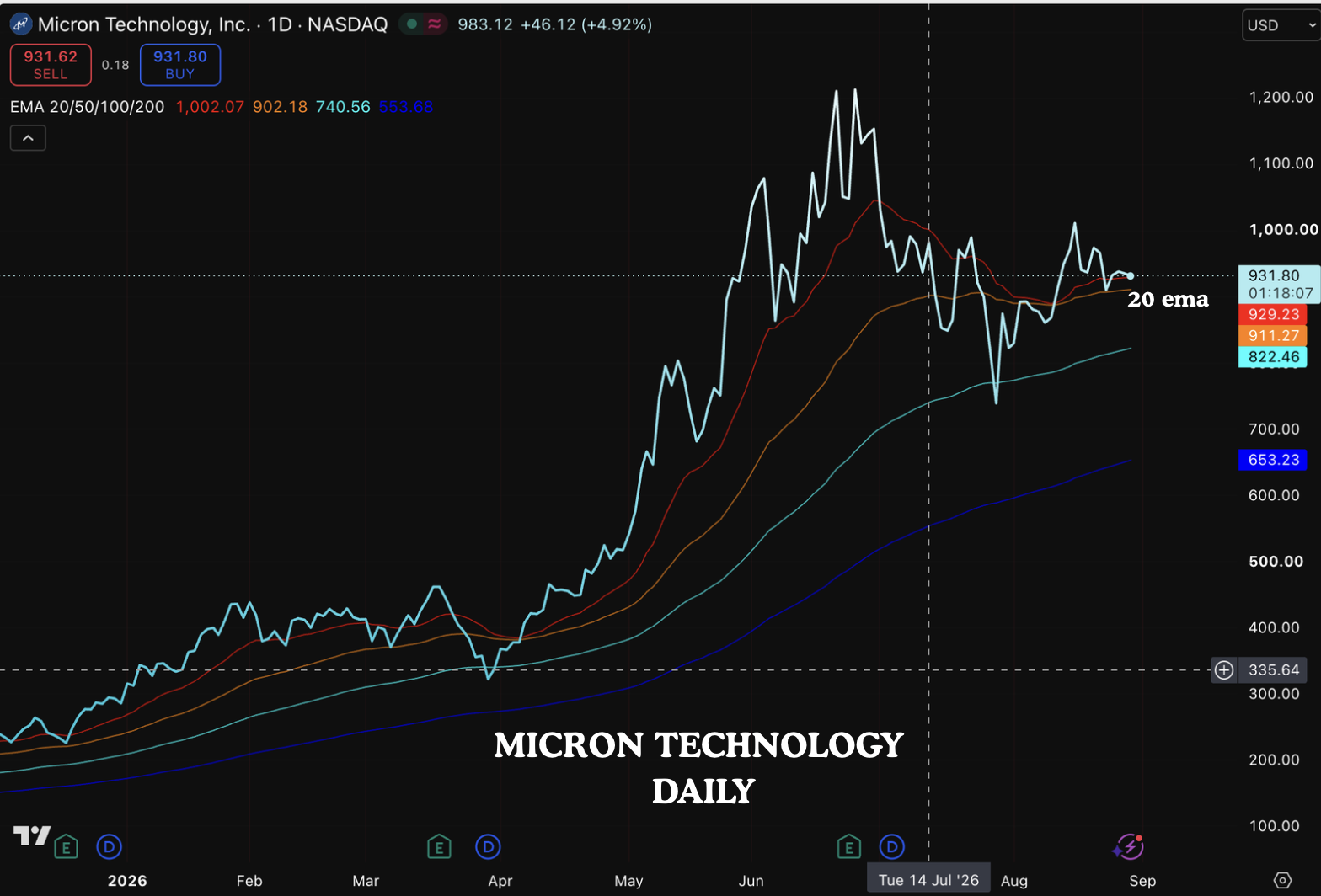
This is the daily chart fo Micron technology. The price has retraced and bounced and price is above th 20 ema. We have entered a long position on Micron technology because we are bullish on overall market. Also on NVDA earnings call, they said that their profits would have been higher if they had enough memory. So the memory market is still high and so this would be considered as a short term bet to look for new highs. But we have an imaginary stoploss of around $850. This is not absolute. We will take a decision based on the over market and the price action of Micron relative to the overall market
Peace be with you all.
